If there’s one thing I simply can’t resist, its the chance to try a new type of workout. As someone who trains for the joy of movement, I always have space for something new and spicy in my plan, so when a fellow trainer friend mentioned that she was taking on classes in a new discipline, I leapt at the chance to give it a go.
I was off to meet the Megaformer.
It doesn’t take a genius to work out that Megaformer is a essentially reformer pilates with an added layer of burn. We’re talking heavier springs, minimal rest, and a painfully slow tempo, designed to facilitate maximum time under tension and improvements in strength and endurance.
If you follow the fitness routines of Megan Markle or Michelle Obama, you might have heard of Lagree; Sebastian Lagree’s amalgamation of essential Pilates principles of stability, core control and postural alignment, bodybuilding, flexibility, and aerobic training. Combining all these elements required him to devise his own machine: the Megaformer. Lagree branded studios all use Megaformer machines, but a studio can offer a Megaformer workout without being part of the offincial Lagree licensing programe.
So, keen to try the workout that has LA’s elites in a chokehold, I packed my grippy socks into my trusted orange rucksack, and made the 50 minute bike ride to the Marylebone branch of ENMEÏ studios.
Despite a cool breeze, the journey into one of London’s most fashionable and affluent areas was quite delightful. Living in the Docklands, studying in Greenwich, and working in the City means it’s rare I venture further West than Holborn. So by the time I was peddling along Harley Street, sandwiched between elegant Georgian townhouses, and towering Victorian red-bricks, I rather felt like a character in Bridgeton.
Flushed by a February chill, I pulled into Cranmer Street, tucked just behind the Waitrose on Marylebone High Street. In most parts, the aforementioned supermarket might be seen as an upmarket establishment, but here it felt quite unremarkable compared to the artisan bakeries, independent delis and gourmet fromageries it sat among. The opulent atmosphere meant I did not feel the slightest concern for the safety of my £35 bicycle as I tethered it to a lamppost…
Though secluded, the studio was relatively easy to find, and the reservations system even easier to navigate, as their website directs you to an app as sleek as the space itself; even the colour schemes align. From here, you can buy passes, book classes, and even receive notifications for exclusive offers, challenges and events.
Helmet in hand, I hobbled into the studio, and was greeted by a front of house staff member wearing a gorgeous turquoise kimono – it wasn’t clear whether this was uniform policy or a personal fashion choice, but either way she looked stunning. The petite entrance area, furnished with a few tasteful sofas, and the tinkling voices of well-spoken locals, offered an ideal place to relax before or after class.
ENMEÏ’s ethos of longevity is immediately apparent; a carefully curated retail area stocks a range of products from the wellness brand ‘healf’ (in addition to branded grippy socks, of course), and two reclining armchairs nestled in the corner allow clients to optimise recovery with use of the compression boots.
Before long, the 4pm group were trickling out of the Megaformer room, glowing, albeit slightly shaky, and our instructor, Anna, was welcoming us in. Upbeat pop serenaded us down a few stairs, into a softly lit space – much bigger than the upstairs lounge – with smooth concrete floors and copper accents. The intimacy of ENMEÏ means that there is no need for jarring tannoys that broadcast progressively more aggressive countdowns to the class start time, and the lack of lockers means there is no fight for space. Instead, members are able to leave their shoes and bags on racks in the corner of the studio, and there are no raised voices whatsoever.
Consequently, the minutes before the class began were decidedly calmer than at many other gyms I’ve attended.
The temperature of the studio was also spot on; warm enough that there were no pre-class goosebumps around, but cool enough that I wouldn’t have to wring out my sports bra that evening.
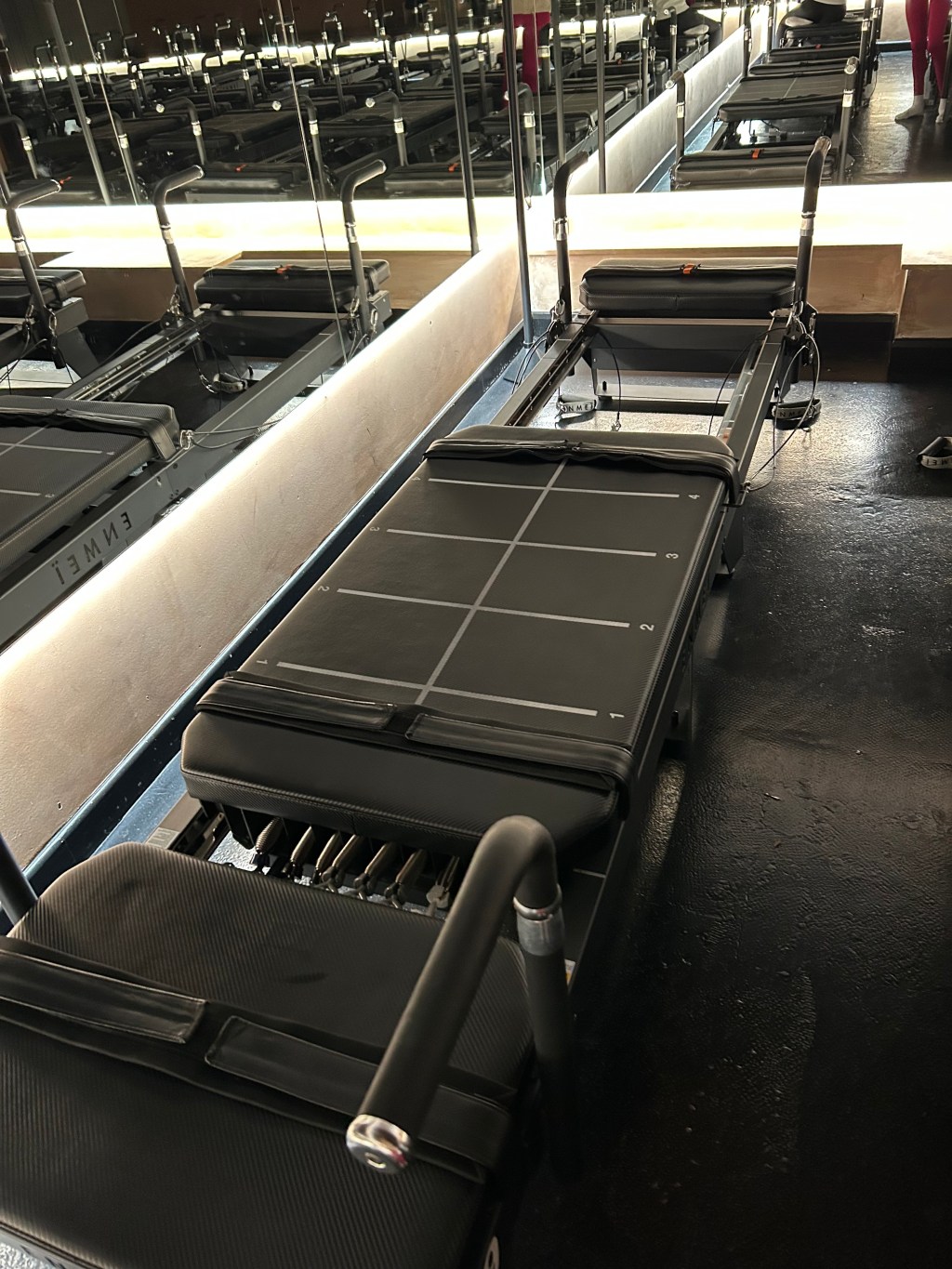
There are a few key differences between a standard reformer, and it’s more strength-focussed cousin; the latter is around 110 cm longer, has two platforms (labelled black and orange for ease of communication) rather than one, and additional handles, bungees and cables at each end. As is the case with a classic reformer, the springs are colour coded, but there are eight, rather than five, which enables a greater range of resistance. Lastly, there are a few sets of dumbbells supplied under each bed…just in case the workout isn’t challenging enough already.
I4 was the only first-timer in this particular class, so Anna dropped her microphone to give me a quick induction to the machine, and a brief explanation of how the class would go.
“I’ll give instructions for the next exercise 18 seconds before you switch, then give you a warning at 10, 5, and 3 seconds” she told me, “this way we minimise rest time. Ready?”
I just nodded, straddling the sliding centre carriage, which has numbered lines enabling the instructor to specify where body parts should be on the 90cm structure.
Anna grinned, and before long we had hit our first plank…
With forearms on line 1, and my toes clinging to the black platform, within seconds I could feel every muscle in my body straining to keep the carriage steady. My abs were already trembling, and heat was rising in my shoulders. As we moved into more dynamic movements, the emphasis on tempo became painfully clear; each muscular extension and contraction was around eight counts long as a minimum. Moving so slowly means you spend a much greater amount of time under tension, therefore maximising the potential to build muscular endurance and density.
Even though the exercises themselves were executed with utmost control, the transitions between them were carried out without any hesitation. Some more experienced attendees were able to transition from isometric glute bridges to elevator lunges in mere milliseconds, zipping from platform to platform at an alarming rate.
Initially, my own transitions were a little shakier, and the first repetition of each exercise characterised by a distinct wobble. Nevertheless, as my confidence built, and I became more aware of where the various handles and straps were, things became a little smoother. The weight of the carriage means that rocketing from platform to platform requires a fair amount of force, but once you trust in the fact that you’re not going to fly across the room, it delivers an almost childlike thrill. I’m a bit of an endurance bunny when it comes to my usual exercise agenda, so I enjoyed the faster pace and lack of lag time, and this continuous motion keeps heart rate consistently higher than in standard reformer. This is just one of the reasons why Megaformer can be considered a cardio session as well as a strength training one; isometric holds recruit lots of the body’s large muscle groups simultaneously, sustaining tension for a minute or more at a time demands continuous blood flow and oxygen, and fast transitions eliminate recovery breaks.
Any iteration of Pilates can offer profound strength, stability and psychological gains for people of any gender. In fact, Joseph himself first created the concept as a way to help injured male soldiers recuperate during the war. Despite this, modern day classes are generally a pretty female dominated environment, so I was pleasantly surprised to see that four of the class’ attendees were (judging from appearance alone, of course) men. The more balanced clientele was refreshing, and the physiques of the males in question certainly served to promote the strength enhancing element of Megaoformer workouts…
The workout progressed through an outer glute series, where even the tiniest of adjustments to foot positioning and incremental pulses were capable of taking my breath away, before we moved on to working the chest. On the Megaformer, classic movements like chest flies become significantly harder (and more effective) than when performed with typical gym equipment, because the mechanism of the springs and handles place the muscles under constant resistance. Furthermore, by holding a standing kneeling position through the movement, the core muscles are pushing hard to stabilise too. When your obliques are already trembling thanks to a – seemingly endless – lateral plank routine, this is no mean feat.
One cannot get through a Megaformer class without paying attention to the breath; not only does it help brace the upper body and provide oxygen to the working muscles, but it also helps calm the nervous system as you battle to keep crunching and lunging. In my case, the combination of intentional breathing and concentrating on accurate movement triggers deeply disturbing facial expressions, so I chose to avoid making eye contact with myself in the studio mirrors. Nevertheless, in the same way that dancers use mirrors to correct their form, watching your body move in a Megaformer mirror is essential to ensure movements are being performed with symmetry, and to optimal depth.
Most fitness studios and gyms have horrendous overhead fluorescent lighting, that leaves even the most bronzed of individuals looking ghostly pale and wrinkly. (Perhaps why bodybuilders are so fond of spray tans?) At ENMEÏ, however, a softer, warm glow, serves to enhance skin tones, avoiding that ‘washed out’ look, and limiting the appearance of blemishes, rather than highlighting them. This may sound like a first world problem, but when you’re staring at yourself in a mirror for nearly an hour, it’s preferable to not feel like Caspar the Friendly Ghost. Not only this, but the golden haze helps the environment to feel calm and intimate.
50 minutes later, my abs were on fire and I could feel muscles in my glutes I didn’t even know I had. This being said, I didn’t feel ‘beaten up’ or as if my joints were suffering – a sign that whilst Megaformer is brutal, it may also be conductive to a sustainable workout routine and (as ENMEÏ puts it) longevity.
The studios were founded back in 2024 by Regina Ekeløf, who, after 10 years in the fitness injury, built a brand with holistic wellness, and one very special Japanese word…
In a similar way to which the Scandinavian concept of ‘Hygge’ doesn’t directly translate to a single English word, ‘Enmeï’ has multi-layered significance. When broken down into is component parts, the Kanji characters mean ‘prolong’ (en) and ‘life’ (Mei). It is used in medical concepts, but is also associated with a Buddhist deity and ritual emphasising longevity and healing, and reflects an intrinsic connection between physical health, spiritual wellbeing, and vitality throughout aging.
With this in mind, it’s easy to see how the studio embodies this concept. On the most fundamental level, there is ample extension of limbs going on in every class, and building core strength is crucial to maintaining good posture and a long spine. It is no secret that regular aerobic and strength training is associated with a long, healthy life and Megaformer builds fitness in a way which isn’t detrimental to joint health in the long run. Furthermore, the peaceful, yet sociable vibe of ENMEÏ, feels nourishing for one’s spiritual wellbeing. There are no showers, fancy hair dryers, or an overpriced smoothie bar – the focus is on the workout. Once again, this is symbolic of Japanese appreciation for simplicity, minimalism and functionality, rather than overcrowding and overconsumption.
In the pursuit of longevity, a balanced approach to exercise is pivotal, hence why ENMEÏ’s programming follows a structure that means the same muscle group is never trained two days in a row, allow members to attend classes consistently, without becoming exhausted, or overworking one area of their body. For example, Monday’s intensity is focussed on the hamstrings and biceps, whereas on Tuesdays, energy is dedicated to the outer glutes and back.
By the time I re-mounted my bike, twilight was descending on Marylebone, and as I made my way along Regent Street and past the eye, I couldn’t help but feel slightly emotional. Though my outer glutes protested slightly to the ride, I was grateful to be able to challenge my body, and as the Thames glittered under the streetlights, I felt strong sense of appreciation for my beautiful city.
As far as pricing is concerned, ENMEÏ sits in a similar bracket to many of its peers, if not offering a slightly better deal. For studio newcomers, they offer a three class trial pack for £60, or seven days of unlimited classes for £80 – which would give you the opportunity to sample each workout, and get to know your favourite instructors. If you decide ENMEÏ is something you want to invest in long-term, then you can purchase credit bundles of various sizes, or monthly memberships. Albeit passes aren’t cheap, nothing in such a premium location is, and the intimate setting means trainers are able to dedicate attention to, and provide coaching points for, every individual in the space.
In essence, for any reformer junkie, the Mega is a must-try, but keep the following in mind:
- Go slow – it’s a true ‘hare and tortoise’ situation – the longer your muscles are under tension, the greater the results will be.
- Don’t go in fasted – whilst heavy meals prior to the class probably aren’t ideal, it is significantly more intense than classical Pilates or reformer. As a result, eating a little something beforehand will help avoid lightheadedness or excessive fatigue.
- Don’t be afraid to modify – as a beginner, the concept might feel pretty alien, and its normal to struggle! The instructor will offer beginner options for each movement, and it’s completely fine to take them.
- It might be worth scheduling a rest day afterwards – Megaformer works muscles you may not have been aware you even had, so it may take some time for your body to adjust to the new stimulus, resulting in more DOMS than you might have expected. As a result, planning a heavy weights session or a long run the day after your first class probably isn’t ideal.

 The Sprightly Spud
Leave a comment